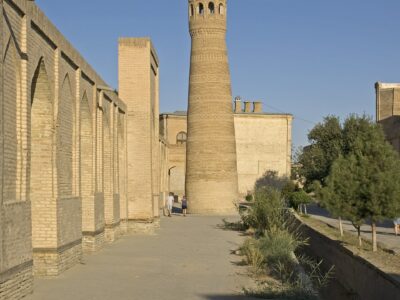
Kalon Minaret & Mosque
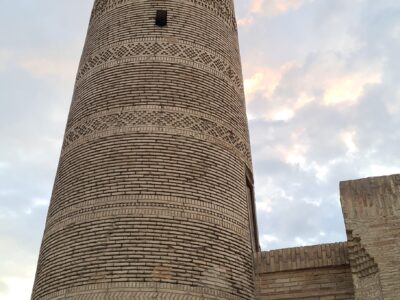
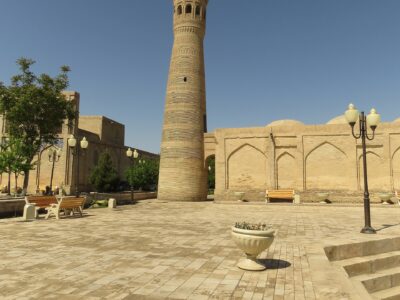
The 47-metre Kalon ('Great') Minaret of 1127 — said to be the only building Genghis Khan ordered spared during the 1220 sack of Bukhara.
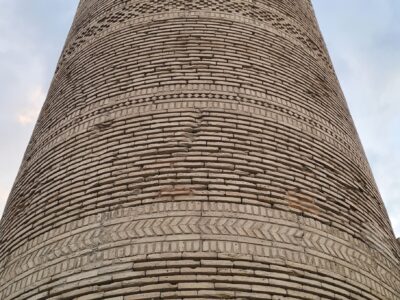
The Po-i-Kalyan (‘At the Foot of the Great’) ensemble — minaret, mosque and Mir-i-Arab madrasa — is the symbolic centre of Bukhara. The Kalon Minaret, built in 1127 by Karakhanid ruler Arslan Khan, stands 47 metres tall on a foundation 10 metres deep, with 14 ornamental brick bands, each in a different geometric pattern, narrowing toward an octagonal lantern at the summit. Local tradition holds that Genghis Khan, when he sacked Bukhara in 1220, ordered the minaret spared — the story varies between his admiration for its beauty and his hat falling off as he tipped his head back to see the top, leading him to declare that what made him bow must remain standing. For centuries the minaret served also as a watchtower and lighthouse for caravans approaching from the Kyzylkum desert; from the 18th century until the Russian conquest of 1868 it was used as the ‘Tower of Death’ — condemned criminals were sewn into sacks and thrown from the top. The Kalon Mosque alongside (1514) holds 12,000 worshippers and is one of the largest in Central Asia. The Mir-i-Arab madrasa opposite, built 1535–1536, is still a working religious school — students live on the premises and can sometimes be glimpsed in the courtyard.