Shah-i-Zinda Necropolis
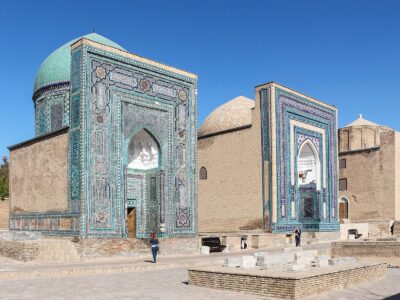
The 'Living King' — a corridor of 11 sumptuously tiled mausoleums dating mostly from 1370–1405, the highest concentration of glazed-tile decoration in Central Asia.
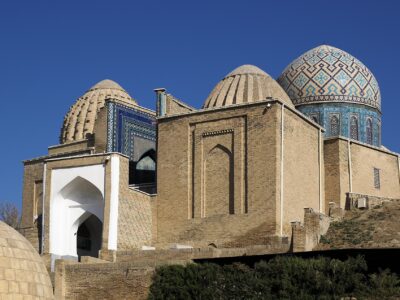
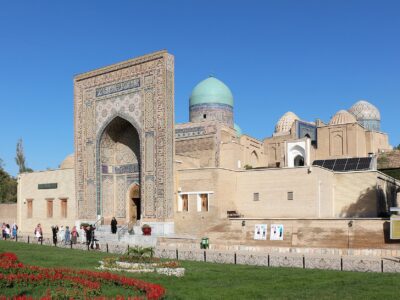
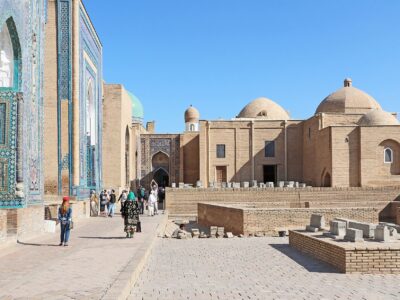
Shah-i-Zinda (‘Living King’) is a corridor-like ensemble of about 20 mausoleums climbing a slope toward the supposed tomb of Kusam ibn Abbas, a cousin of the Prophet Muhammad killed defending Samarkand from a Mongol attack in the 7th century — local tradition holds he was beheaded but went on living, hence the name. The earliest tombs were built in the 11th–12th centuries; the largest and most ornate were added during Timur’s reign and his immediate successors (1370–1430), commissioned for his daughters, sisters, generals and senior officials. Each mausoleum is a small, tall building with a single domed chamber; what makes Shah-i-Zinda extraordinary is the tile work — every facade and every interior surface is covered with carved terracotta, painted majolica, mosaic faience and inscriptions in Kufic and thuluth scripts. The corridor is narrow and sequential, with each mausoleum framing a view of the next — the architectural rhythm is one of the masterpieces of Central Asian Islamic art. The ‘Tuglu Tekin’ mausoleum (1376) and the unnamed but famous ‘octagonal’ mausoleum (1430) are widely considered the high points.