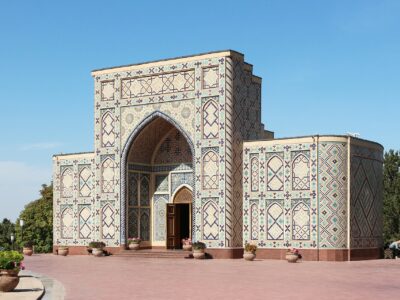
Ulugh Beg Observatory
The remains of the 1428 observatory of astronomer-king Ulugh Beg — featuring the largest pre-modern sextant ever built.
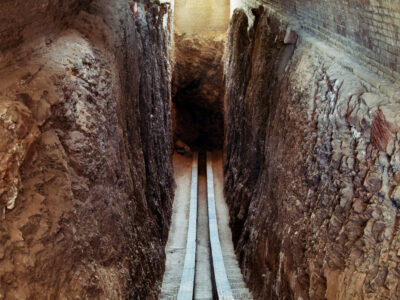
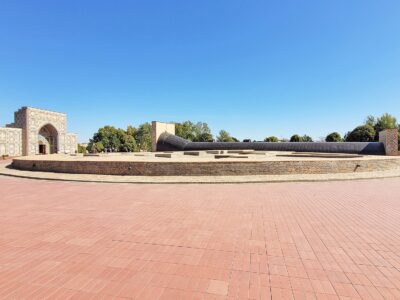
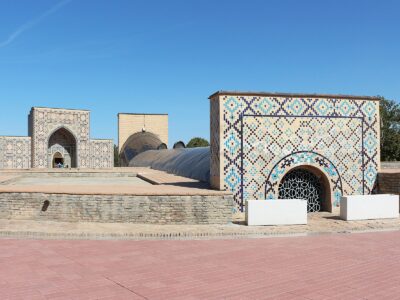
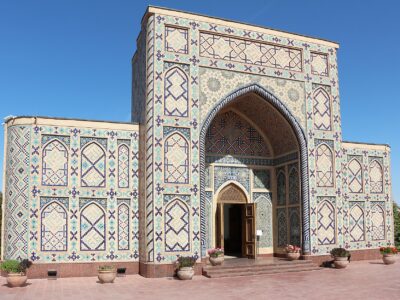
Ulugh Beg (1394–1449), grandson of Timur, became governor of Samarkand at age 16 and ruled until 1449. Unlike his ancestors he was not interested in conquest but in mathematics and astronomy, and he transformed Samarkand into the most advanced scientific centre of its time. Around 1428 he completed an enormous observatory on a hill north of the city, the centrepiece of which was a Fakhri sextant 40 metres in radius — built into the bedrock so that the curved arc was the segment of a circle whose centre lay below ground. With this instrument and a team of mathematicians including Ali Qushji and Jamshid al-Kashi, Ulugh Beg compiled the Zij-i-Sultani — a star catalogue of 1,018 stars with positions accurate to within a few minutes of arc, a precision unmatched for almost two centuries until Tycho Brahe in Europe. The observatory was demolished by religious fundamentalists shortly after Ulugh Beg’s assassination in 1449; only the underground portion of the great sextant — a stone arc 11 metres deep — was rediscovered by Russian archaeologist Vyatkin in 1908 and is now visible in a covered trench at the site. A small museum on the hill displays scale models, translations of the Zij-i-Sultani and a chronicle of Ulugh Beg’s life.