Bibi-Khanym Mosque
Timur's Friday mosque (1399–1404) — at the time of construction the largest mosque in the Islamic world.
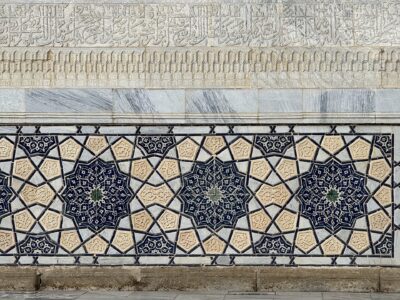
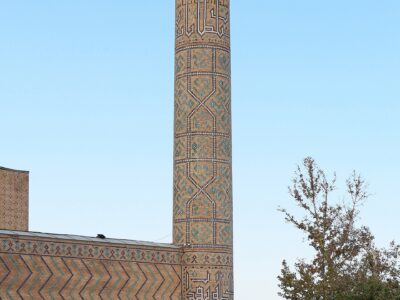
Bibi-Khanym is one of the most ambitious — and ill-fated — buildings of the Timurid empire. Built between 1399 and 1404 on Timur’s orders to mark his victorious campaign against the Delhi Sultanate, the mosque was intended to be the largest in the Islamic world and a public statement of Samarkand’s primacy. The complex includes a 35-metre-high portal, a main prayer hall with a 41-metre dome, two minarets at each corner of the courtyard, and an enormous 167×109-metre rectangular plan. Construction was rushed (Timur reportedly ordered the architects executed when they faltered), and the structure began to fail almost immediately — bricks falling from the dome during the inauguration. By the 18th century the mosque was largely in ruins; the current state, with much of the dome and portals reconstructed, dates from Soviet restoration in the 1970s onward. In the courtyard stands a giant marble Quran lectern said to have been carved on Timur’s orders to display the Caliph Uthman’s Quran (the original is now in Tashkent); local tradition holds that crawling under it three times grants women fertility. Bibi-Khanym is named after Timur’s senior wife, Saray Mulk Khanum, and a popular legend (probably 19th-century in origin) involves a young architect, an unauthorised kiss, and the introduction of veiling in Central Asia.