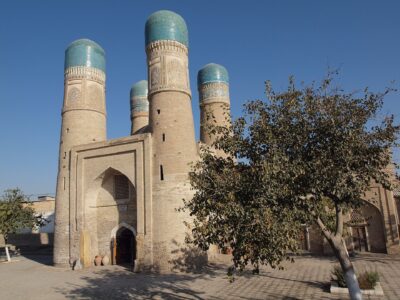
Char Minar
A small four-towered madrasa gatehouse from 1807 — Bukhara's most unusual and photographed silhouette, often mistaken for a mosque.
Char Minar (‘Four Minarets’ in Persian) is one of Bukhara’s most surprising monuments — a small but visually striking gatehouse to a (long-vanished) madrasa, built in 1807 by Khalif Niyazkul, a wealthy Turkmen merchant who had converted to Sufism. The four corner minarets are not minarets in the religious sense (they have no muezzin platforms) but ornate towers with onion-like majolica domes — each tower decorated with a slightly different pattern of blue and turquoise tiles, and topped with a stork’s nest. The building’s footprint is unusual — almost square, more reminiscent of Indian Mughal architecture than the Persianate monuments common in Bukhara. The madrasa students’ cells once surrounded a small courtyard behind the gatehouse, but the cells were demolished in the early Soviet period; only the four-tower entrance survives. Tucked away in a residential quarter of the old town and a 10-minute walk from the main monumental zone, Char Minar feels like a hidden discovery despite being firmly on the tourist map.