Registan Square
The most magnificent ensemble in Central Asia — three madrasas (15th–17th c.) framing the public heart of Timurid Samarkand.
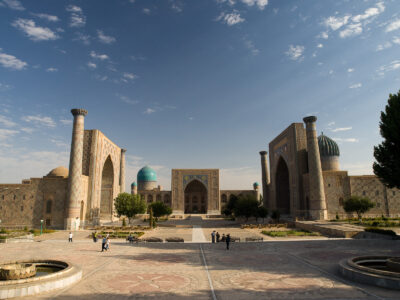
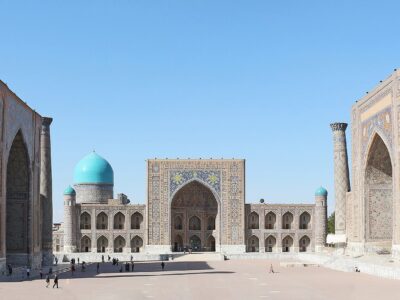
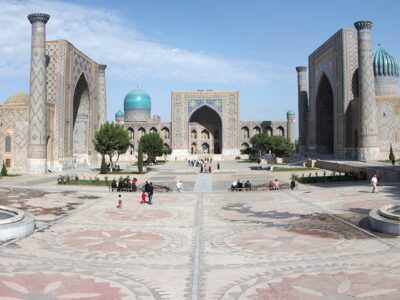
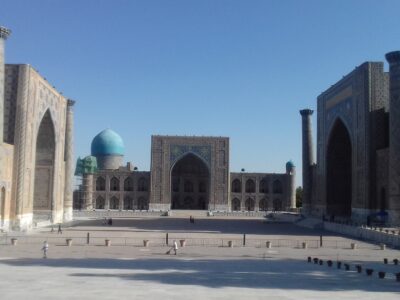
Registan (‘sandy place’ in Persian) was the public square at the centre of medieval Samarkand — a ceremonial space where caravans were inspected, executions performed and royal proclamations announced. The three monumental madrasas that now frame it are not contemporaries: Ulugh Beg madrasa on the west (1417–1420) was built by Timur’s grandson, the famous astronomer-king, and originally hosted the most distinguished mathematicians of the time including Ali Qushji and Jamshid al-Kashi. Sher-Dor madrasa on the east (1619–1636) is famously decorated with two pairs of striped Persian-tiger-like ‘lions’ chasing a stag (with a human face inside the rising sun behind them) — a unique figural transgression of Islamic decorative norms reflecting the Shaybanid khans’ looser interpretation. Tilya-Kori madrasa on the north (1646–1660) is the youngest, with the most extensively gilded interior in Central Asia — its prayer hall ceiling is entirely covered in gold leaf, making it shimmer when sunlight enters through the arched openings. UNESCO inscribed the Registan and the surrounding historic centre of Samarkand on the World Heritage List in 2001 as the ‘Crossroad of Cultures’.